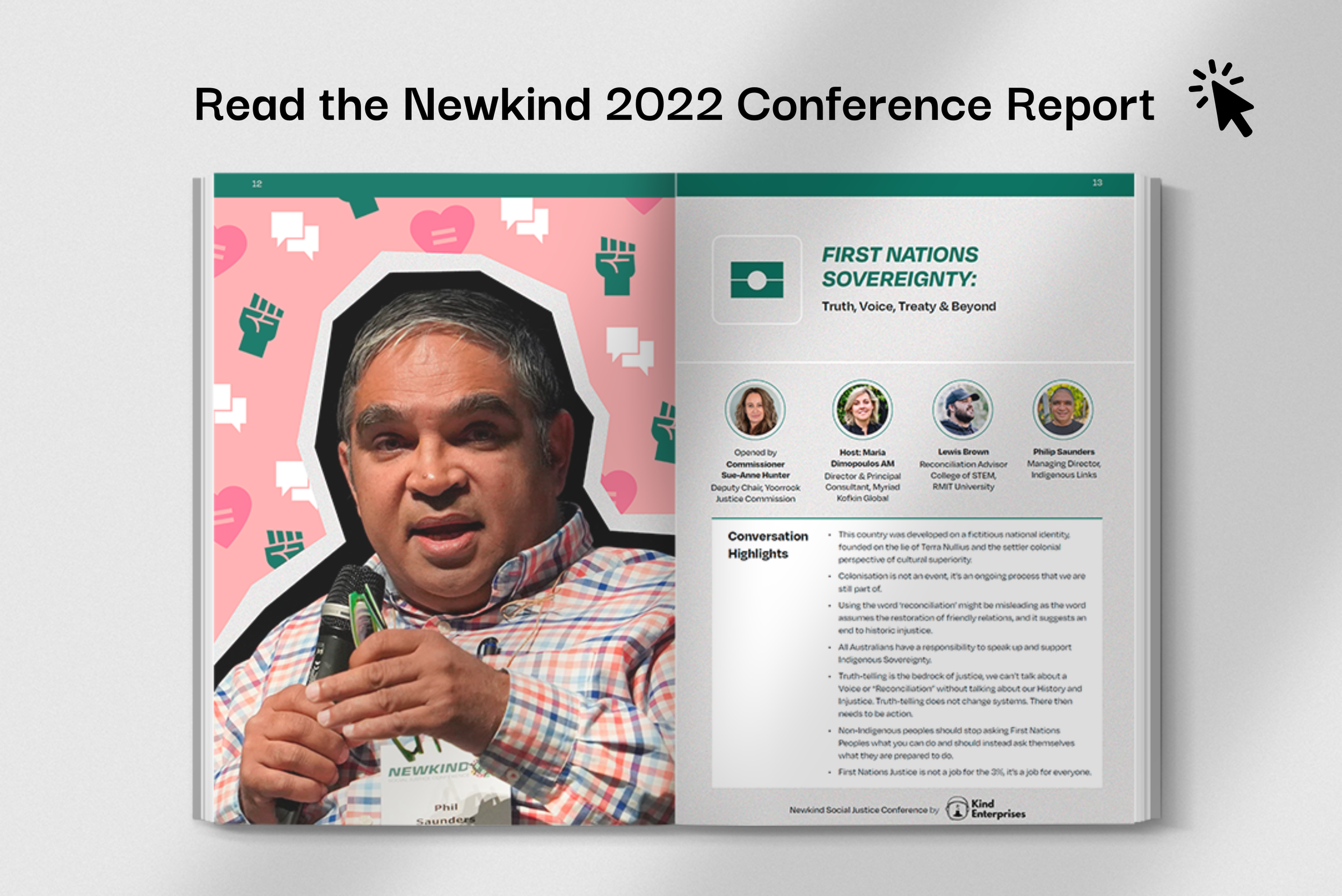
First Nations Sovereignty: Truth, Voice, Treaty & Beyond
Speakers:
Opened by Commissioner Sue-Anne Hunter, Deputy Chair, Yoorrook Justice Commission
Host: Maria Dimopoulos AM, Director & Principal Consultant, Myriad Kofkin Global
Lewis Brown, Reconciliation Advisor, College of STEM, RMIT University
Philip Saunders, Managing Director, Indigenous Links
Conversation Highlights
This country was developed on a fictitious national identity, founded on the lie of Terra Nullius and the settler colonial perspective of cultural superiority.
Colonisation is not an event, it's an ongoing process that we are still part of.
Using the word 'reconciliation' might be misleading as the word assumes the restoration of friendly relations, and it suggests an end to historic injustice.
All Australians have a responsibility to speak up and support Indigenous Sovereignty.
Truth-telling is the bedrock of justice, we can't talk about a Voice or "Reconciliation" without talking about our History and Injustice. Truth-telling does not change systems. There then needs to be action.
Non-Indigenous peoples should stop asking First Nations Peoples what you can do and should instead ask themselves what they are prepared to do.
First Nations Justice is not a job for the 3%, it's a job for everyone.
Summary of Speaker's Points
Commissioner Sue-Anne Hunter
1. I work for the Truth and Justice commission. Yoorrook is a Wemba Wemba word for truth. It's not the truth and reconciliation commission, it is the truth and justice commission.
2. We need to address and redress systemic injustices that fall upon our people. Our Elders guide us to the doors that we're supposed to walk through. We have to be strong enough and have the courage to walk through that door and into spaces where we're not welcome and speak our truth.
3. Sovereignty was denied, but never ceded. And Sovereignty requires self-determination and the right to make decisions for oneself and one's community - land, law and people.
4. We don't want to determine other people's lives. We have never ceded land. You're on my land.
5. The systems that locked us away and our children are the same systems that we will use against them. The Yoorrook Commission will create a lasting public record of systemic injustices to bring all Victorians with us on a journey of deep listening.
6. Every step of the process needs to be respectful and culturally safe. This will be painful, but stay in that moment, because it has been painful for us all our lives.
“The question is now, what can you do about it?”
— Commissioner Sue-Anne Hunter
Lewis Brown
Discussed the challenge of decolonising pedagogy and curriculum and how crucial it is for the process of truth, reconciliation and justice. He spoke of the love for the aesthetics of Indigenous culture and stories, but a tangible dismissiveness and lack of engagement when the conversation shifts to deaths in custody, health gaps and land back.
1. "Invasion is not an event, it is an ongoing structure that is still harming our people".
2. The naming of places is instrumental in perpetuating colonialism, or working towards healing.
“Please stop asking me, 'what can we do?'. Ask yourselves what you are prepared to do.”
— Commissioner Sue-Anne Hunter
“There was more than one perpetrator that murdered Cassius. One perpetrator was also a system of institutional racism… It is the same system that locks up Cassius’ brothers and sisters. It is the same system that killed William and Kumanjayi… We are not (just) individuals. We are fighting a system that has failed us again and again and again.”
“Say their names. Over 400 people have died since the inquiry into Aboriginal deaths in custody in 1991. Truth telling is but one tool in this fight.”
- Commissioner Sue-Anne Hunter
The panel also discussed the need for Indigenous data sovereignty and story sovereignty, so that stories and statistics out there are not just used as fodder against communities to perpetuate further colonisation through white-led policy initiatives.
People need to consent to have those stories being used and also academia and literature needs to create space for First Nations Peoples to tell their own stories, conduct their own research, and influence their own policies. For too long, Indigenous Studies has been an anthropological approach of studying "the other".
Commissioner Hunter spoke to the disparity in expectations, where if an Aboriginal Commissioner leaves, it's called "in-fighting" because we're Black, whereas in a white Commission, it's referred to as "administrative issues". This was called out as intentional literary acrobatics with the motivation to derail.
“I am for the truth no matter who tells it, and I am for justice no matter who it is for.”
— Malcom X
Philip Saunders
1. We cannot talk about a Voice to Parliament unless you talk about our history. It's the living and breathing wreckage that we're still living in today.
2. This is not just a job for me or for 3% of the population. We need the rest of the population. This is a grassroots movement.
3. Speak up for me when I'm not in the room. I don't have to know about it, but know that you already have my thanks.
4. Colonisation is not in the past "this is still happening to us".
“The first point of call, for me, is to have an honest and sobering conversation about the history of this nation.”
— Philip Saunders
The word reconciliation was also unpacked and its inadequacies highlighted. "Reconciling" implies that we have some sort of relationship and that it is the responsibility of First Nations people to fix it. How can you reconcile when something was built on mistrust and continued marginalisation?
The pace of racial justice - the panel reminded us that we can't be complacent and the pace needs to be increased. What are we doing outside of the hours of 9-5? How are we being vigilant? And how can we address the fact that, when push comes to shove, we're reminded that we're living in the colony.
A whole lot of healing needs to happen. The harm of the prison industrial complex was discussed and the need to prioritise culture and healing was raised. Commissioner Sue-Anne Hunter said "when they go to prison, spirituality and culture dies".
“It does wonders for a person to listen and be still and listen to someone else's life… you never know what you will learn.”
— Archie Roach